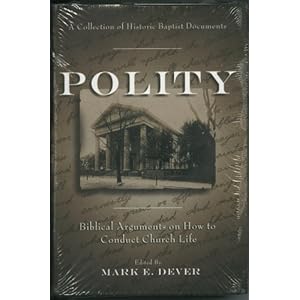
 Mark Dever's sizable tome Polity: Biblical Arguments on How to Conduct Church Life is a helpful work in this regard. In its 586 pages are contained three modern essays (by Dever, Greg Wills and Al Mohler), followed by 10 historically significant Baptist treatises on essential elements of church life. The earliest of these is by Benjamin Keats and dates back to 1697, while the most recent by William Williams (one wonders what his middle name was) was written in 1874.
It has been hugely helpful to me to step back, outside of our modern approach to church planting and polity, and read what great thinkers of the past have recommended. A few points have emerged as regular and important themes that contrast with some of our modern expectations or practices, including:
- Churches were created not through the strenuous solo efforts of a church planting pastor, but when a group of Christians in a local area agreed to come together and commit themselves to being a congregation. After this, they would call a minister to serve as their pastor.
- Pastors received their ordination and commissioning directly from their congregation rather than relying on an external ordination body such as a denomination, although there was considerable variation in this area.
- Closed communion (restricting the Lord's Supper to those who were members and in good standing) was quite common among Baptist churches.
- Even these biblically-informed men had significant blind spots, including actively dismissing the Scriptural model of a plurality of elders as being a temporary requirement that applied only to the heavily persecuted early church. A single elder/pastor was the rule in almost all of these churches.
- Most of these authors were well aware of the tendency of pastors and denominations to extend their authorities beyond biblical bounds, and they established strict limits to fight creeping authoritarianism.
And may we all seek with vigour to pursue the Bible's plan for church polity, to the glory of God!

No comments:
Post a Comment